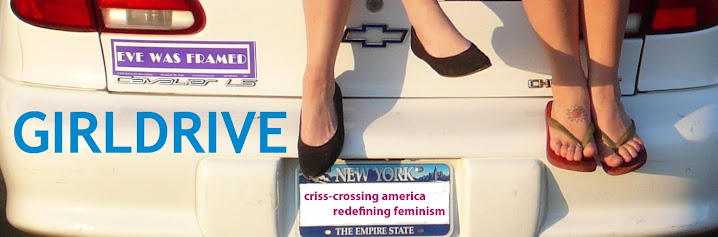
Saturday, August 30, 2008

Philly: CILLE AND THEMBI

Thembi (left): 29, originally from Philly, works for an educational testing service, really wants to be a "media maven--a writer and a talking head," writes a blog called "What Would Thembi Do?", a blog about black pop culture, among other things.

"One of the main things I'm disappointed about is that women don't band together more over sexual health. Don't ever have a women's health problem, because it will destroy your life. It makes me so mad the way doctors act toward something as personal as a reproductive system--which, by the way, are half female, it's not like it's some crazy thing that we can't understand. But if there's something wrong, the doctor is not able to say anything besides, 'Wait and see what happens.'...None of this, including breast cancer and diseases that affect women, has been addressed properly."

Cille (right): 24, originally from Philly, currently working for the city in emergency management, wants to pursue a Masters in public policy and a law degree--to become the "good" Condoleezza Rice.

"I relate to the term 'womanist' more than 'feminist.' It has a spiritual essence in it that you can't really divorce from the Black female experience. Feminism is not rooted in the spirit...it's too political. Womanist thinking is always based in theology: identifying the spirit in both men and women and making them whole, but in particular it relates to Black women and how we've been able to use the spirit of the Creator to heal our families and ourselves, and to take care of people and be the breadbaskets and mules of the world. What has sustained us over that time has been a spirit, whether it be God, whether it be whatever you believe in. [For many black women] that word has a more prominent meaning than feminism does."

Monday, July 28, 2008

New York: LIKWUID


Likwuid: 26, born and raised in Columbia, SC, hip hop artist (her music linked here), personal trainer, learning how to DJ, has her own company, Royalty Media Group, which works on changing how women are viewed in hip hop.

"There are numerous women that are making great music. But if you let the industry tell it, they say, 'Oh, women don't sell, women artists are too hard to work with, you gotta do their fashion, their budgets.' I'm like, 'Please, you got men walking around with blue chinchilla coats.' The excuses that come up with women, they just don't add up. The problem really is that hip hop is so focused on objectifying women that they can't even step out and take an objective look at the situation. These women aren't selling because you're creating the same Barbie over and over again. When we had Queen Latifah, MC Lyte, it was balanced, it was beautiful, they had their individual style. Now they're taking women out of the picture and people are saying hip hop is dead. Of course it's dead! How you gonna have life with only one gender?"

Wednesday, July 23, 2008

Mid-Week Memo: Women and Rock

In Philadelphia, we caught up with Emily, 26, right, who is the lead singer of Philly-based electro-pop outfit Pony Pants.  She is the server of gelato by day, rock star by night, feminist all the time.  She had some thoughts about women in music:
“I put a lot of energy and thought into performances, and I have rarely had anyone imply that it’s bullshit because I am a woman. There have been a couple of guys that come up to us after a show and will be just gushing about all the guitar riffages, and the gear, and the amps, and I’ll be like…didn’t you like the singing? And they say, “not really my thing.”

"Generally what happens more is that girls come up to me and want to hug and talk about their projects and it's fucking amazing. They will express that they really admire me, stuff I would have never expected. I figured people were over it. I see bands with girls in them all the time, in every capacity, and I love it. Sometimes when we’re on tour we get paired with bands just because they have girls in them, which is cool and I don’t mind at all, but guys in the audience will more frequently be like “Come on, you're not even in tune,” which is so stupid. I have the biggest soft spot for bands with girls, even if they are bad. It’s the whole Riot Grrrl, cult of amateurism stuff. Bands that are like “we don’t know how to play, but we are just going to fucking do it, because it feels good.”

Monday, July 21, 2008

Trip to New York: MARISOL

Marisol: 22, native New Yorker, first-generation American, a financial analyst at one of the most famous investment banks in the world. Is going to quit next year and get her post-bacc to be a doctor.
(There she is, left, crossing Wall St)

On being a woman in the investment banking world:

"Surprisingly maybe, investment banks in New York are very modern in terms of women, childcare, minorities, diversity--they have it down. And you have to separate these banks from the rest of corporate America, like AT & T or GM, companies that are very old-fashioned. In those places, I feel like the environment for women is a lot different. My investment bank is five years ahead, not because they're feminists or anything...it's just that they realize that to work in the modern world and to get the best types of people you have to provide certain services and environments, otherwise you're going to lose women. There are three women in my group who recently have children, and they are provided with a childcare center in the building. That's better than other industries with more women, like publishing."

Saturday, July 12, 2008

Overheard in Chicago #7: Summer Shows

partying after the show: me with rebecca and jen of tyler john tyler

I arrived at the Sic Alps show on Saturday night, overwhelmed by the stench of male B.O. and stale Old Style. I scanned the crowd with my eyes, looking for a glimpse of that girl presence that always makes me feel so comfortable at shows. I elbowed my way to the front, so that I could see above all the 6-foot-tall bodies, and spotted some of the only other girls I know from the rock music scene bouncing along to the riffs.

A while later, I turned to one of my guy friends and said, "Man, it's so weird that there's not very many girls in the music scene in Chicago." He answered me, "Believe me, we're happy to have you. Before all you girls came onto the scene, who were we supposed to fuck?" He later told me he was kidding, that he knew we all played music, but the comment left a bad taste in my mouth. Did our gender make it necessary for the dudes in the scene to think of us as "groupies," and not as fellow music-lovers?

--Emma

Tuesday, July 8, 2008

Mid Week Memo: RYAN AND NATHAN

In the early stages of GIRLdrive, we were reminded of a group of people that feminism sometimes glosses over: the transgender community. On our recent trip to the East coast (during New York's Pride Week), we talked with a genderbending woman and a transman who is currently passing at the workplace. This is what they had to say:

Ryan (left) is 26, born and raised in Queens, works at a real estate office, has been training for the last 2 years to be a firefighter. She identifies as genderqueer, and changed her name to Ryan earlier this year because she "never felt comfortable with [her] given name."
"Sometimes I feel more identified as female, and other times I feel more identified as male, depending on my situation. But then I start to think, 'It's based on the situations I'm in only because I'm thinking in terms of the definitions I've been taught.' I'm assigning language to behavior, but it seems kind of unnatural to me...I feel like the world is really in a struggle of borders, which have become the metaphor of my life. There's a struggle to cross borders and to keep things out. Confronting this will be important for feminism, I think, but more generally for just figuring out how to co-exist in the world."

Nathan is 22, lives and grew up in Philly, quit college last year, works for a pharmaceutical software company.
"I don't think that my decision to transition [into a man] makes me any less of a feminist, because the reason I transitioned is unrelated. My understanding of feminism is for both sexes to be equal--in ability, capacity, rights, everything. I can't say that switching really takes away from that. And I feel like I can make a difference from the inside...because now I am thought of as a man with other men. I don't pull out a whiteboard and write, 'Here's how not to objectify your wife.' But I do express feminist ideals covertly and I think it helps when guys hear it coming from guys."

Monday, July 7, 2008

We're back!

We're safe and sound in Chicago, after a whirlwind tour of DC, Philly, and good old New York. Check back tomorrow for a combo Profile-Midweek Memo!

-N and E

(to the left is a photo of us in Telephone Bar & Grill in the East Village on 6/24, the same place where we first planted the seeds for GIRLdrive almost two years ago!)

Monday, June 23, 2008

GIRLdrive in DC, NYC, and Philly


Dear Faithful Readers,
This week the blog goes on hiatus as we are in NYC, Philly, and DC conducting interviews and visiting our friends and family.

We are in NYC: June 20-27, June 29-July 2
Philly: June 27-28th
DC: June 28th-30th

If you know any awesome ladies to interview, please send them our way!
--E & N

Sunday, June 22, 2008

Overheard in Chicago #6: Angie

While taking publicity stills for Chicago based performance artist Angie, 23, right, we got to talking about life as a young lady in the theater arts world:

“My work has a lot to do with promoting my sexuality and understanding its power over people, especially men. Working in the performing arts, I’m not a stripper, but I feel that sex appeal is important…I am always hyper aware of my own use of my sexuality, and I use it to get what I want and I don’t think there is anything wrong with that, because the converse of that is just being naïve and exploited. Woman [in the performing arts] are still completely objectified, especially in Chicago…They are not enough women in the performing arts in this city that are comfortable harnessing their sexuality in a way that is healthy and not exploited or commercial... The reason I am in performance is because I appreciate the fact that I can bring three dimensionality and depth to common notions of womanhood you see in flat advertisements and movies, being in the performing arts I take action against these commodified versions of femininity by bringing to life another version...”

--EBB

Thursday, June 19, 2008

Mid-Week Memo: Words from the Guys

detail from painting by Emma's mother, Susan Bee, titled "Girly Man,"
and the cover for a book by Emma's father of the same name

This week, we collected a few quotes from men on the topic of feminism--are they feminists, and what does feminism mean to them?

"I feel like men and women both need to be uplifted from where they're at, and in our society, women are more marginalized. So in the same way that I might be more aware of people that are poverty-stricken, or minorities that have had a harder experience in our country, I'd say I'm a feminist in the way that I'm aware that women are often subordinated in our society, or underappreciated. But I don't think you can uplift just women without changing the way that men approach it as well. The balance is very important, and it's a two-way conversation."
--Aaron, 26, production assistant and freestyle MC in New York

"I think I'm a feminist, but that doesn't mean that misogynist qualities aren't ingrained in me. I think that's true for women, too. I think I respect and am sensitive to women's issues, but I still find myself expecting women to act a certain way. I still say stuff like, "That chick is hot." I am feminist to the extent that I question how things exist now, but I'm still very much a product of mainstream 'guy' culture, whether I like it or not."
--Aaron, 27, waiter and writer in Chicago

"I am not sure how to answer the question of whether or not I consider myself to be a feminist. Of course, feminism means different things to different people, but it doesn't mean much to me. Do I respect people regardless of their gender? I would say yes -- at least I try to. If someone demonstrates themselves as worthy of respect, their gender really doesn't matter to me. However, I have a very different opinion of people who allow or choose to have the question of their gender (woman, man, trans, whatever) play too great a role in defining themselves." Matt took his thoughts in a more philosophical direction after this, wondering whether gender distinctions themselves create unbalanced power structures. He wondered: should we look past gender to find some mythical sexless human essence, or is there some merit to be found in embracing hierarchal structures? Click here to read his musings in his own words.
--Matt, 24, paralegal in Chicago

Sunday, June 15, 2008

Overheard in Chicago #5: Open Mic

While waiting to hear our girl Deliza perform at an open mic over the weekend at the Bassment, we overheard a choice exchange.

The female emcee (right) asked one of the guy rappers, DJ Uh-Oh, if he was intimidated by the amount of ladies stepping up to the microphone.

He didn't hesitate to retort (left): "Some of these b-girls are coming harder than niggas," he admitted. "I ain't gonna bite my tongue."

Cheers and shout-outs ensued.

Tuesday, June 10, 2008

Mid-Week Memo: JADINE

This is Part III of a series dedicated to
Contemporary Art & Feminism


Last Saturday Nona and I had the pleasure of attending a graduate student symposium curated by Woman Made Gallery in honor of the Feminist Art Project. We sat through hours of presentations, with paper topics ranging from 1970’s confessional video art, to the use of string and embroidery to represent femininity in visual practice, to the repercussions of the “L-Word” on lesbian stereotyping in the media. It was the first time I have been to such an intimate gathering of art history and feminism nerds, and not been the youngest member of the audience. Most of the gals presenting and listening (unfortunately there were few men in attendance) are daughters of the third wave, yet there was a sense of scholarship and dedication to second wave artists that should serve as a placating reminder to intergenerational worry worts.

The youngest panelist was my college friend Jadine, 23, (above, middle) who now works for Woman Made Gallery. She presented her brilliant thesis on the performance artist Orlan (which I workshopped on when we were fellow art history students). Jadine also was one of our first interviewees, back in April 2007. We caught up with her after the conference to see how her opinions on art and feminism have developed over the past year:

“Interning at Woman Made gallery has changed my viewpoint a lot. It’s easy theoretically for me to feel like that there is no need to essentialize female identity, that females that are doing good work should just emerge. But, I’m seeing that in the everyday market reality there is a need to assert an essentialist identity of women to just get them equal opportunities to display their work.”

Last weekend Jadine and I were both in attendance at a panel discussion on “post-black” artists, put on by the Renaissance Society museum. The structure of the post-black argument echoed that of contemporary post-feminist artists, women artists who don’t want their gender mapped onto their artworks. How this plays out when race and gender intersect was, astoundingly, never brought up. I asked Jadine: Can you be a post-black, post-feminist artist?

“Somehow art made by women has a lot more fudge room then art by black artists. Everyone doesn’t expect female artists to make art about feminist issues, but it seems very hard for a black female artist to make art that’s not read in terms of race.”
jadine, april 2007
--EBB

Sunday, June 8, 2008

Overheard in Chicago #4: RACHEL

While browsing in a Logan Square flower shop, called Fleur, we struck up a conversation with one of the florists, Rachel. She clued us into the reality of "Bridezillas," telling us:

"I never really thought the Bridezilla thing was real until I saw it in person. Brides can really get controlling. They put all this money into one day, when it could go into a year of traveling. And it usually is a sign of a marriage that's not going to last, if they care that much about flower arrangements. Men care sometimes, too, but it doesn't seem to be much of a big deal to them."


Is this a true stereotype? Why do women put so much emphasis on one little day?

Wednesday, June 4, 2008

Mid-Week Memo: McCain Madness

In the last few days, a disturbing phenomenon has caught our attention: incensed Hillary supporters are pledging their support for McCain, refusing to jump on the Obama wagon. Collier, 23, (left) one of our childhood friends and a lady who's never afraid to speak her mind, is our personal political consultant and political-blog expert. She had some choice things to say:

"I don't think it's fair to say that this largely white and older block of women are being hysterical and irrational--necessarily. However, I do think that older, white women feel like they were owed something, that it was their time to shine. And this was a huge blow to their collective ego, that somehow a younger, swifter (maybe too swift) black man took their moment. But these same women were the ones who by and large support the right to choose. These are the same women who believe that every American deserves access to affordable health care. And they would be doing a disservice to Hillary Clinton (their presidential hopeful) and all of the work she did surrounding the preservation of a woman's right to choose and healthcare if they voted for McCain.

They are not hysterical but they want to be heard. This is their way of being heard. It's an empty threat. They will come to their senses, both because Hillary Clinton will remind them of McCain's increasingly conservative anti-choice record. He used to believe in abortions for rape victims and victims of incest but since he needs to bring in those uber-conservative voters, he has denounced all abortion. They will come to their senses because they themselves will remember all that they struggled for. I don't think this is something that upstanding feminists should be concerned about. If white women do stay home or vote for McCain, it's because they're insane."

Monday, June 2, 2008

Chicago: LAUREN

Back in April of last year, when I met up with Emma in Chicago to do a few sample interviews and test out GIRLdrive, one of the feminists we interviewed was Lauren Berlant (left), a professor of English at the University of Chicago and an influential feminist thinker. To this day, we still consider it one of the most important interviews we did, one of those long, meandering conversations during which you have several epiphanies. We remember one moment in particular, when Lauren addressed the issue of reconciling "work" (feminism, intellect) with "play" (happiness, sex). It's stuck with us ever since:

"As an intellectual, feminist or not, you are constantly being called to say what you are thinking and describe what you are doing all the time. Then there are these spaces for an interruption or a relief...the “appetite” spaces, like eating and fucking and watching TV and hanging out with your friends. What feminism hoped for was forms of pleasure that would also be about self-development, where your forms of self-cultivation would also be your pleasure. We have to admit that pleasure is not just about eloquence, culture, clarity. Its also fogginess and sex. Once you think about sex as a place where you lose control, it’s to some extent contrary to intellect and feminism as a theory. If feminism is about control, and sex is about losing control, how do you reconcile that?"

--NWA

Sunday, June 1, 2008

Overheard in Chicago #3: Post-'Sex and the City'

On Saturday night, we eagerly went out to see the Sex and the City movie with a few of our friends. Over pizza and martinis (of course), we "couldn't help but wonder": did Sex and the City portray women positively or negatively?
*warning: slight spoilers below*

Matt: I found some of the portrayal of women in Sex and the City to be kind of offensive. The general impression I got from most of the characters (the redheaded lawyer one being the exception) was that women are vapid, self-absorbed, and capable of self-reflection only when pushed by others ...which isn't really self-reflection after all, is it? (Matt had a lot more brilliant things to say about this issue. Check out more of his thoughts here).

Antonia: I disagree. I don't think the movie was sexist. I thought Samantha's storyline especially was uplifting--that she chose to be independent in the end.

Emma: But what about all that overeating bullshit, the fact that they made such a big deal about Samantha gaining 15 pounds? That was lightweight offensive.

Antonia: Yeah...but it's realistic. Some women do turn to binge-eating to deal with stress.

Collier: I thought the movie was very materialistic, and stuck in the late nineties, 'First Wives Club'-status.

Antonia: I don't think the show is insinuating that ALL women are materialistic, and I don't think there is anything really wrong with materialism! (check out her full diatribe here)

For Nona's opinion, check out her review of the film for VenusZine.

Wednesday, May 28, 2008

Mid-Week Memo: The Virgin

Note: This is Part 1 in a 3-part series discussing Chastity, Purity, and Promiscuity.

The other day, Rosa,* 16, confessed to us that she had been raped when she was 9 by a family friend. "I'm fine now," she told us. Her voice wavered but her strength and poise was obvious. She seemed to have accepted what had happened and moved on. But our hearts broke when when she shared how it's affected the way she looks at love and sex:

"[My boyfriend now] knows what I've been through, and he don't even kiss me. We'll hold hands and he'll ask me if it's okay. I met him at church. There was a time where I came out to the church, because they were like, "Come up to the altar if you need healing because you've been raped or molested." So I went up there and he started praying for me...and I finally was able to give my problem to God. I really struggled with forgiveness, but now that I've started to go to church, I've forgiven the man who raped me. It was wrong, it was a mistake he did, but in God's eyes, I'm still a virgin, I'm still pure."

Our stomachs sank, not only because Rosa had been hurt, or because she was only a child when it happened, but because she fundamentally felt stained by the rape. No matter how she had let her life blossom, the most important thing to restore after she was raped was her "purity"--her virginity. Now that Rosa had gotten a second chance at guarding her sexuality, she barely lets her boyfriend touch her. On some level, she was admitting that she will forever think of sex as something to defend herself against, not to enjoy.

The reason for this dread is partly psychological--no 9-year-old is ready for sex, much less outright violation. But the social construct of virginity and purity is also so ingrained in our culture that who can blame Rosa for feeling impure and dirty? Why are we so fascinated by this tiny little piece of skin that, up until a few decades ago, was usually not even up to a woman to "give up"? Virginity is still a huge deal. Virginal pop stars are alternately idolized and scorned. "Virginity pledges" in the shadow of abstinence-only education are on the rise. Teenage girls constantly fret about what makes you "technically a virgin" (see Schechter's movie trailers, below). Not to mention that the whole idea of virginity is based on heterosexual relationships, leaving an entire population of homosexual women and men out of the equation.


Most unfairly, people couldn't care less about teenage boys losing their virginities. Guarding sexuality is almost purely, so to speak, on the shoulders of a woman, implying that the only one who would even want to have sex is unquestionably the man. Rape will always be unthinkably painful, but it could be a lot easier to heal from it as a young girl without the added job of "gatekeeper."

Emma and I have been obsessed with the topic of virginity ever since this road trip began. Emma is sinking her teeth into Hanne Blank's Virgin: The Untouched History, and I've been patiently waiting for Therese Schechter’s documentary The American Virgin (her website is where I stole that cherry photo). Schechter calls virginity "the cornerstone of Western civilization." It's a term that's only started to be questioned and broken down, and pop culture has a long way to go before they quit dichotomizing Madonna and whore.

*name has been changed

Discussion Question 1
Discussion Question 2

Monday, May 26, 2008

Chicago: DELIZA

Deliza is one of the ladies we've met through Step Up Women's Network. We got to know her a little while back when we profiled her for Student of the Month (check out the article here), which is an honor given by Step Up to a particularly inspiring, diligent, and committed young woman who is part of the Teen Empowerment program. Deliza (left, in her pantry-turned-studio at home) is 16, was raised in Puerto Rico and Chicago's Humboldt Park neighborhood, goes to North Grand high school, and plans to be a famous singer/dancer/choreographer (she already writes her own songs).

Deliza freely told us her steadfast opinions on everything from teen pregnancy to women's roles in the Latino community, but "feminism" was a new word and concept for Deliza. Emma and I tried as best we could to explain the many facets of what feminism could mean. We gave her a little history, told her that it's all wrapped up in choices, happiness, sex, family, love. We quoted one of her fellow Step Up girls, Maryann, who said that "being a feminist is not feeling like you just have to be in the kitchen and pop out babies." This is what Deliza had to say:

"If someone called me a feminist, I think I would agree. It's like what Maryann said, there are so many opportunities out there. You don't have to be what people want you to be. I am going to take a stand for it...You know when your parents tell you, 'You can do anything you want'? I really took that into consideration. I believe I can do whatever I want, and no one's going to stop me. Not a man, not a female, not the government, not Bush. I am my own person. So with the definition that you guys have given me, I would see myself as a feminist."

--NWA

Sunday, May 25, 2008

Overheard in Chicago #2: DARYL and JOEY


A coincidence: While Emma was out of town, I had two unrelated but quite similar conversations about GIRLdrive and our stance on international feminism. We've touched on this issue a few times (Siman from Phoenix had a lot to say about it), but it has not come up in a while.

The first conversation I had was with Daryl, a 25-year-old behavior consultant for an organization providing services for people with autism. She works in Berkeley but was in town for a conference, and I met her randomly at the tail end of Saturday night. When we got on the topic of the very American story of GIRLdrive, Daryl had a lot to say. "Our struggles are nothing compared to what international women go through," she commented over an Old Style. "I know you guys are trying to figure out where American feminism is headed, but in my daily life, I feel fine. I feel like I can say what I want and do what I want for the most part." Although tentatively identifying as a feminist, Daryl made it clear that basic human rights were her priority--and not necessarily sweating the "small stuff."

The next day, I heard something similar--from a boy. Joey, a twentysomething dude from Humboldt Park, Chicago, was in a car with me and happened to ask me why I moved to Chicago. I told him, and he had a similar reaction to Daryl's: "When I think of what needs to be done in terms of feminism, I think of other countries. It's all relative."

What do you guys think about this issue? Should GIRLdrive go global? Or is the search for feminism via a Chevy Cavalier a very specific American trope? Tell us your thoughts.

--NWA

Wednesday, May 21, 2008

Woman Made Gallery: AMY

This is PART II of a series of blog entries devoted to
I recently sat down for a conversation with Amy (above), gallery coordinator for Woman Made Gallery in Chicago, the midwest regional coordinator for the Feminist Art Project, and adjunct Art History prof at DePaul University.

On having a women only gallery: “Woman Made couldn’t be called a feminist gallery because we have shows that are abstract and geometric. Feminism has a connotation that is more political. Its really important to have that kind of show because women artists are underrepresented in the art world and just because an artist does abstraction or geometric forms doesn’t mean we can’t be an advocate for them. Being an advocate for all women artists is where the name Woman Made comes from. For our audiences the idea of a feminist made gallery would mean political art. Would more people come to the gallery if it was called WM gallery, would more collectors buy from us? What connotations are we promoting with our name? Ultimately it's not about identity, its about women being underrepresented in the art world.”

On younger artists aversion to being labeled feminist: “We had an emerging art show called ‘Feminist Interrogations,’ all about how feminism can be used as a tool of social activism. I encouraged younger artists associated with our gallery to apply, and a lot of them didn’t. Their idea of feminism was about images of women and this way we think about feminism traditionally. It seems there is a gap there in terms of how younger artists are getting involved with feminism and making it relevant to their lives… There are young artists who don’t want to show here. They don’t want to make that distinction, that their work is only supposed to be shown at a Woman’s Gallery, they don’t want to put that on their record. They don’t want the issue of personal identity associated with their work, and I can understand that, but I would still advocate for them.”

--EBB